The European Business Wallet
One portable, verified digital identity for your business — valid across all 27 EU Member States. Anchored in European law, tested at European scale.
Your business identity, everywhere in Europe
Verified credentials work in all 27 EU Member States — issued once, valid everywhere.
Tested in 30 countries via WE BUILD
The European Commission's selected Large Scale Pilot programme is testing the EBW at European scale.
You decide what you share
Selective disclosure: only the data a transaction requires — never more, never less.
The European Business Wallet in brief
The European Business Wallet (EBW) is a secure digital wallet for legal entities — companies, institutions and organisations — enabling them to present verified business credentials to trade partners, governments and platforms across the entire European Union.
The EBW is anchored in Regulation (EU) 2024/1183 — the revised eIDAS Regulation — and was the subject of a dedicated legislative proposal by the European Commission in April 2025. It is the business counterpart to the EU Digital Identity (EUDI) Wallet for citizens.
What distinguishes the EBW is its combination of portability, cryptographic verification and privacy by design. Credentials are issued once by trusted public authorities — national business registers, tax authorities — and are thereafter valid everywhere in Europe. You always decide what you share, with whom and for what purpose.
For businesses operating cross-border, this is not an abstract policy story: the EBW is the infrastructure that replaces fragmented, country-by-country verification processes with a single standardised, trustworthy identity layer.
Why this is relevant for you
- Cross-border business without repetitive verification per country
- Mandates and powers of attorney provable digitally and transparently
- Direct connection to mandatory B2B e-invoicing via ViDA (deadline: 1 July 2030)
- E-invoicing endpoint as a verified attribute in the wallet
- Selective disclosure: you only share what is strictly necessary
- One European infrastructure instead of 27 national systems
Latest eWallet News
Stay Updated
The European Business Wallet — background, technology and impact
What exactly is the EBW, how does the technology work and what does it mean for the way European businesses transact? An accessible explanation based on formal EU sources.
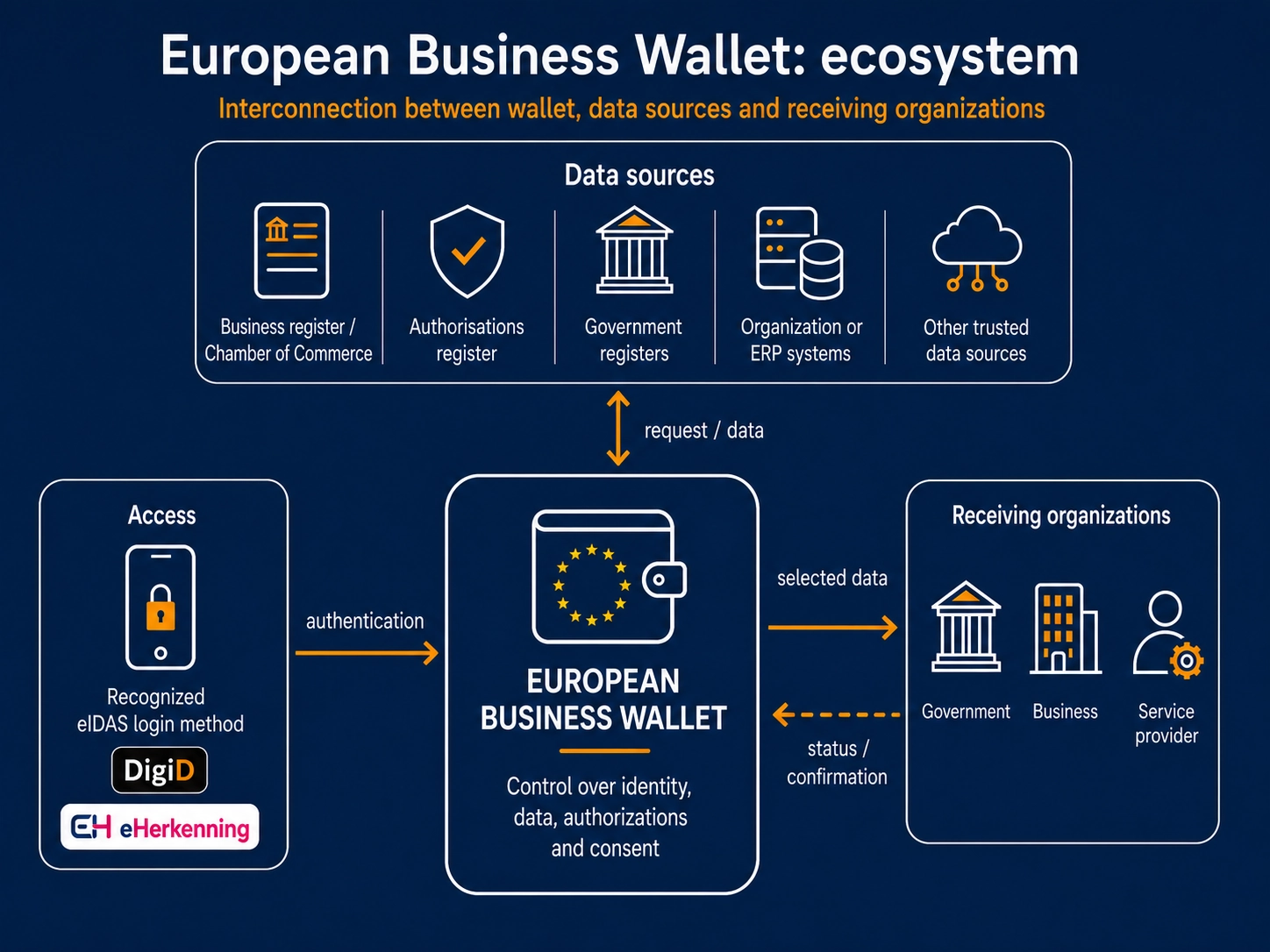
Background: what problem does the EBW solve?
Businesses operating cross-border in Europe today face a fragmented landscape of national business registers, varying access procedures and non-standardised verification processes. Identifying a new international trade partner — who is this company, is it registered, what is the VAT number and where do I send an invoice — requires a different approach in each country.
Credentials are issued by the nationally competent authority — the Dutch KvK, the Belgian KBO, the Swedish Bolagsverket — cryptographically signed, and stored by the organisation in its wallet. A counterpart in another Member State can verify that credential in real time, without having to consult the issuing register separately.
Objectives of the European Commission
The European Commission formulates three core ambitions for the EBW in the legislative proposal of April 2025 (source: EC press release IP/25/2718):
Reduction of administrative burden. Businesses present their identity and attributes once in a standard format, instead of going through separate verification processes in each country.
Strengthening the internal market. A common digital identity layer lowers the barrier for cross-border transactions, procurement and service delivery for businesses of every size.
Security and reliability. Credentials are cryptographically signed and traceable back to trusted public issuers — tax authorities, business registers, sector authorities.
The technology behind the wallet
The EBW is built on the technical standards of the EUDI Wallet Architecture and Reference Framework (ARF). Three core principles underpin it.
Decentralised identity. There is no central database. Credentials are issued by national authorities, stored by the wallet holder themselves and verified via cryptographic signatures. No party has a central overview of all transactions.
Interoperability. The European Commission's implementing acts establish uniform technical standards, so an EBW issued in the Netherlands also works at a government counter in Spain or with a trade partner in Finland.
Qualified Electronic Signatures (QES). The EBW supports the placement of QES — legally equivalent to a handwritten signature throughout the EU (eIDAS 2.0, Article 25).
Social impact
Autonomous data management. In the current digital landscape, businesses disclose more data than strictly necessary at every transaction. The EBW works with selective disclosure: you release only the specific attributes a transaction requires. This strengthens businesses' control over their own corporate data.
Transparency of role and mandate. An employee signing a contract or authorising an invoice on behalf of their organisation can demonstrate via the EBW that they are authorised to do so — including the scope of that mandate. This makes abuse harder and gives trade partners direct certainty about a representative's authority.
Level playing field for SMEs. Large enterprises always had the resources for complex cross-border verification processes. The EBW democratises access to the European internal market: international business becomes more accessible and less costly for smaller businesses too.
The EUDI Wallet: the citizen's wallet alongside the EBW
Official definition
The EUDI Wallet is defined as an electronic identification means that allows the user to securely store, manage and validate personal identification data and electronic attestations of attributes, and to provide these to relying parties and other users of European Digital Identity Wallets. This is the definition from Regulation (EU) 2024/1183 (eIDAS 2.0), Article 1.
Purpose and background
The 2014 eIDAS Regulation laid the foundation for European electronic identity, but adoption remained limited. eIDAS 2.0 significantly extends its scope: beyond authentication for government services, the wallet is now also deployed for private services — banks, aviation, telecoms. Member States are required to make a EUDI Wallet available to citizens and residents by the end of 2026.
The ambition: every citizen or resident of the EU can use their digital identity everywhere in Europe — to log in, sign documents and prove attributes — without having to create a new account or present paper documents for each country or service.
How does the EUDI Wallet relate to the EBW?
The EUDI Wallet and the EBW are complementary. The EUDI Wallet holds personal attributes: driving licences, diplomas, health cards. The EBW holds organisational credentials: registration data, VAT numbers, mandates. In practice, an employee combines both: they authenticate themselves via their EUDI Wallet and then demonstrate via their employer's EBW what authority they have to act on behalf of that organisation.
EUDI Wallet — Key facts
- Legal basis
- Regulation (EU) 2024/1183 (eIDAS 2.0), in force 20 May 2024
- Member State obligation
- Available to all citizens and residents by the end of 2026
- Scope
- Online government services (mandatory) and private services (banks, aviation, telecoms)
- Technical standard
- Architecture Reference Framework (ARF) + EC implementing acts
- Large Scale Pilots
- WE BUILD, EWC, POTENTIAL, DC4EU (four consortia)
- More information
- digital-strategy.ec.europa.eu
European Business Wallet in action: e-invoicing from action to payment
Abstract policy documents become concrete once you see how a workflow will look in the future. Below, we describe — as a world first — how a European Business Wallet works when sending an e-invoice: from triggering the action in your ERP system to the confirmation of payment. Secure, compliant and largely automated.
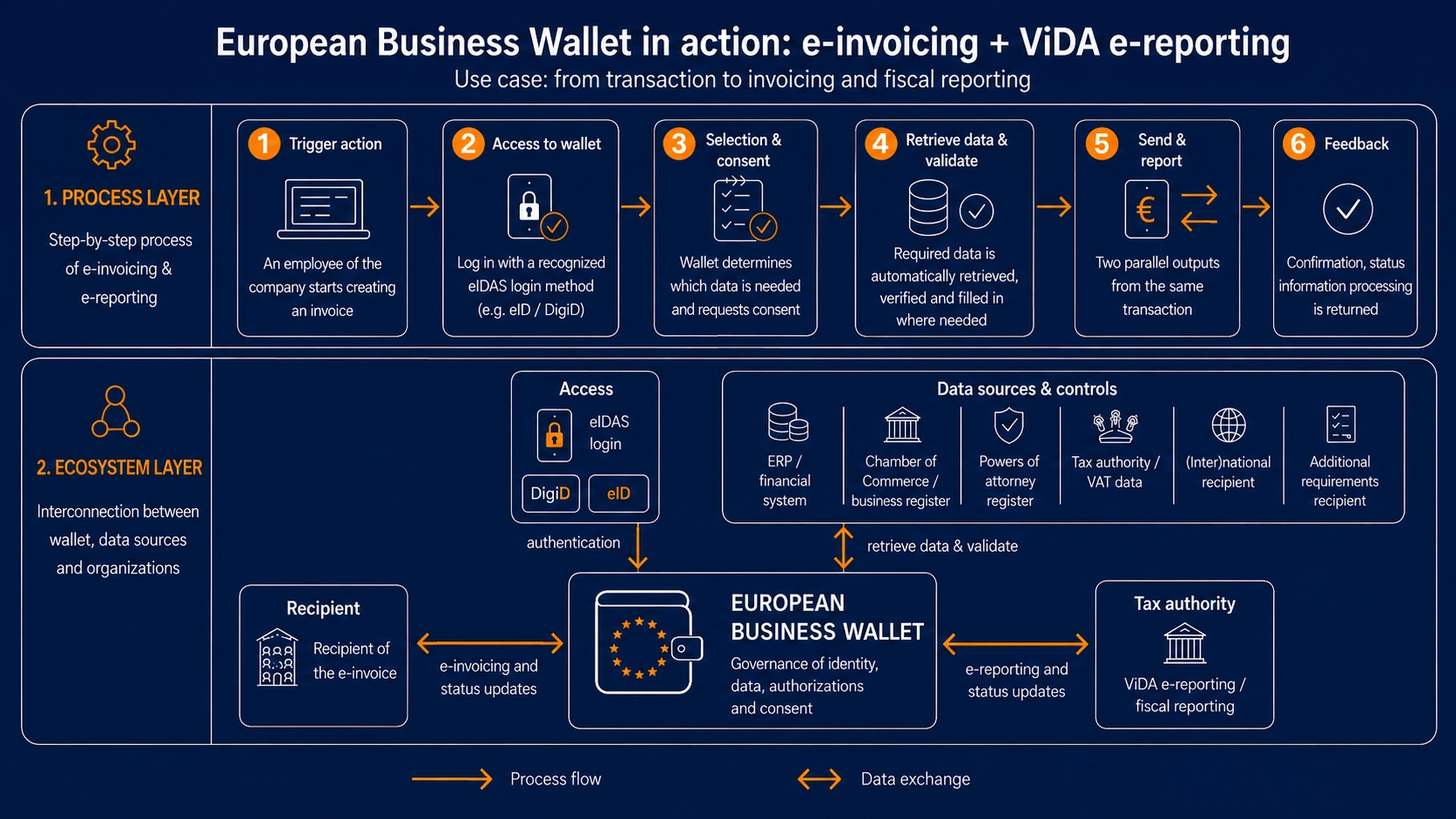
Trigger the action: the e-invoice initiates the process
It does not begin with the wallet — it begins with the work. An employee creates a sales invoice in their ERP system or financial application and opts for e-invoicing. That moment is the starting signal: the application communicates to the European Business Wallet that an action is taking place for which verified business data is required.
This is a fundamental reversal compared to today. Currently, an employee must manually gather, validate and enter data. In the EBW model, the action itself triggers an automated data process — the wallet takes over the work as soon as it gains access.
Gain access to the wallet via an eIDAS means
Before the wallet can release data, the user must prove who they are — and whether they are authorised to act on behalf of the organisation. This happens via a recognised eIDAS means. In the Netherlands these are DigiD (for citizens) and eHerkenning (for business use). Other EU Member States have comparable means, all compliant with the eIDAS 2.0 standard.
Authentication is not just a security step — it is also the connection between the person behind the screen and the mandates stored in the wallet. Via the Power of Attorney Register, the wallet can cryptographically demonstrate that this user is authorised to approve invoices on behalf of their organisation, and up to what amount or transaction type that mandate extends.
Request & Selection: the wallet determines which data is needed (Pull 1)
Once access is granted, the wallet compiles a request: which data are legally required to correctly build and address this specific invoice? That request is not generic — it is precisely calibrated to the type of transaction, the parties involved and the applicable regulations, including ViDA requirements for the structure of e-invoices.
The data sources the wallet consults at this stage encompass six categories:
This is the moment at which the EBW solves the classic three-layer problem in cross-border e-invoicing in a single architectural step.
Verification & Retrieval per data source: what is automatic, what is not? (Pull 2)
Not all data is always digitally available or connected. In the second pull phase, the wallet checks for each required piece of data whether it can be retrieved automatically via a connected API, or whether the user must enter it manually. The degree of automation depends on how far the digital disclosure of registers has progressed — and that varies by country and by type of data.
In the most advanced scenario — expected to become the norm once the EBW infrastructure is fully operational — Chamber of Commerce registration data, VAT status, the recipient's Peppol network information and mandate data are retrieved directly and automatically.
Push: send the invoice via the correct exchange network
Once all required data has been collected, the wallet builds the e-invoice in accordance with the legal structure — including ViDA compliance — and sends it via the recipient's exchange network. In the vast majority of cases that is the Peppol network and the recipient's corresponding Access Point.
The EBW does not replace Peppol — it sits architecturally upstream of it. Peppol handles the transmission; the EBW ensures that the addressing, identity verification and authorisation are watertight before the invoice enters the network.
Status messages: feedback from dispatch to payment
E-invoicing does not end with sending. The European Business Wallet receives after dispatch a sequence of six standardised status messages, tracking the complete lifecycle of the invoice — from transmission via the network to the final payment confirmation.
Privacy & Control: the user always retains authority
What distinguishes this scenario from existing automated invoicing systems is the role of the user as owner of their own data. The European Business Wallet shares no data without explicit consent — each attribute is released on the basis of granular consent. Only the data the transaction requires is shared. Never more, never less.
- User gives consent per transaction (Granular consent)
- Only selected data is shared — selective disclosure
- Full audit trail and logging of all data sharing
This use case is currently being tested within WE BUILD — the European Commission's Large Scale Pilot consortium — as use case SC5 (Supply Chain / e-invoicing), led by OpenPeppol.
WE BUILD Consortium & formal sources
The WE BUILD Consortium brings together 190+ organisations from 30 countries. Below you will find direct links to the official sources and WE BUILD member organisations.
Frequently asked questions about the European Business Wallet
Factual, based on formal EU sources: eIDAS 2.0, EC publications and WE BUILD documentation.
Ready to get started with e-invoicing?
Europe is building the digital infrastructure for business transactions — Peppol.nu keeps you informed at every step.
Peppol.now - Your guide in the world of electronic invoicing
Social Media