Made possible by SEEBURGER, Partner of Peppol.now
International Einvoicing and ERP Migration: What the STABILO Case Teaches Us
This article is based on the case study published by SEEBURGER about writing instrument manufacturer STABILO International GmbH. We use that case as a starting point for a broader analysis of questions that are relevant to many internationally operating companies: when do you choose Peppol, when do you choose a clearance model, and what does that mean when you are migrating an ERP system at the same time?
The situation: active in multiple countries, each with its own einvoicing requirements
Companies that invoice internationally do not operate within a single einvoicing system. Worldwide, three dominant architectures exist, each with their own countries and logic:
- Decentralised — invoices are exchanged via certified service providers, without a central government gateway; examples include Peppol in Belgium, Denmark, Norway, Singapore, Australia and the UAE (5-corner model), and DBNAlliance in the United States (Peppol-inspired, not yet mandatory)
- Clearance — every invoice passes through a government gateway before the recipient may process it; examples include SDI in Italy, KSeF in Poland, CFDI via SAT in Mexico, DIAN e-factura in Colombia, NF-e in Brazil and EFS/MBS in Nigeria
- Hybrid — decentralised exchange via certified platforms combined with mandatory fiscal reporting to government; examples include Verifactu in Spain and PA (Plateformes Agréées) with PPF in France (mandatory from September 2026)
The common driver behind all these mandates: governments use einvoicing as an instrument to modernise their VAT systems. By making invoice data available in real time or near-real time, tax authorities can reduce VAT fraud, close tax gaps and make collection more efficient. The technical architecture — Peppol, clearance or hybrid — follows from that policy objective.
For a company active in several of these markets, this means concrete operational differences: per country, different technical requirements, different formats, different reporting obligations and different deadlines apply. The question is not whether you will encounter this complexity, but how you manage it.
The SEEBURGER case study describes how STABILO — a manufacturer of writing instruments with production sites in Germany, the Czech Republic and Malaysia, active in more than 180 countries — faced exactly this challenge. The company had country-specific einvoicing solutions running for Italy, Hungary and Spain, each through a separate provider. That worked, but it also meant multiple contracts, multiple integrations, and multiple compliance responsibilities. When Poland (KSeF) and France appeared on the roadmap, it became clear that this model was not scalable. The full case study describes how STABILO fundamentally reassessed that approach in the run-up to its SAP S/4HANA migration.
Peppol or clearance? Three architectures, three logics
The choice of an einvoicing solution is fundamentally a choice about architecture — and that choice depends heavily on the markets you operate in.
The decentralised model operates without a central government gateway in the transaction flow. Invoices are exchanged via certified service providers based on shared standards. Peppol is the most widely adopted example of this model.
The clearance model works differently: every invoice passes through a central government gateway that validates — or in some cases approves — the invoice before the recipient is permitted to process it. Italy’s SDI works this way. So does Poland’s KSeF. Without validation by the government platform, an invoice in these countries has no legal standing.
The hybrid model combines elements of both: invoices are exchanged via certified private platforms, while the government simultaneously receives fiscal reporting data. There is no central validation requirement per invoice, but the government has real-time visibility into transactions. Spain’s Verifactu and the French system with Plateformes Agréées are examples of this approach.
Once a country makes B2B einvoicing mandatory, this has direct compliance consequences for every company invoicing in that country: you must comply with the architecture the relevant government has chosen, not the architecture you find most convenient. For purely nationally operating companies, the choice is therefore relatively straightforward — there is only one applicable system, and the compliance question is primarily an implementation question: which provider helps me set this up properly?
For companies active in multiple countries, the situation is more complex. They operate simultaneously across multiple architectures, with multiple formats and multiple deadlines. What that means in practice is the subject of the next section.
What this means for companies doing business internationally
For a company that invoices internationally, einvoicing is no longer optional. It has become a prerequisite for operating in certain markets at all. The question is not whether you will encounter it, but in which countries, at what point in time — and whether your current solution can handle it.
That is more concrete than it sounds. A company supplying Italian customers has had to deal with mandatory invoicing via the SDI system for years. Anyone doing business in Belgium has had to be fully operational for Peppol invoicing since January 2026. A company with activities in Mexico or Colombia has long been working with centralised clearance systems such as CFDI and DIAN. And companies expanding into Asian markets like Singapore or Australia encounter Peppol-based obligations that are already active there. The common thread: every country has its own system, its own timeline and its own technical requirements.
For companies operating from the Netherlands, an additional dynamic applies. Since 18 April 2019, all contracting authorities have been required to receive and process einvoices, but suppliers are not obliged to send them. The central government and various individual public organisations have used this situation to contractually enforce einvoice submission. The expectation is that the Netherlands will also adopt Peppol for B2B: in March 2026, EY advised the Dutch Ministry of Finance — in its report ‘ViDA e-facturatie en digitale rapportage’ — to recommend Peppol as the standard for mandatory B2B einvoicing in the Netherlands. Peppol.now published an analysis of the EY report. A formal policy decision is still pending, but EY’s recommendation is clear.
The strategic question is therefore not only: am I compliant in the markets where I currently operate? But also: is my solution capable of absorbing the obligations ahead — without every new market requiring a new implementation project?
The ERP migration as a strategic moment for einvoicing
A migration to SAP S/4HANA — or to any modern ERP system — is demanding enough without einvoicing being managed as a separate parallel track. At the same time, such a migration offers a unique opportunity: the moment when existing connections, providers and contracts are already under scrutiny.
What the STABILO case illustrates is that this combination can yield strategic advantage. By reviewing the einvoicing strategy before the ERP migration — rather than after — the migration itself becomes less complex. Fewer providers, fewer integrations, more architectural coherence. That reduces not only the technical complexity during the transition, but also the ongoing management burden afterwards.
Concretely: a provider that handles both ERP integration and international einvoicing compliance removes coordination work that would otherwise need to be managed internally. That is particularly relevant for organisations without large IT departments, or for organisations where the SAP migration is already consuming capacity.
How SEEBURGER addresses this challenge
SEEBURGER addresses the challenge described above — multiple countries, multiple architectures, one ERP — through the SEEBURGER BIS Platform. That platform integrates einvoicing, EDI, API connections and managed file transfer in a single environment, connecting to the customer’s ERP system through one interface.
In practice, this means:
- Peppol exchange and clearance systems (SDI, KSeF, ChorusPro) are handled through the same platform, without separate contracts per country
- Compliance updates — new formats, changed country requirements — are applied centrally by SEEBURGER; customers do not need to reserve internal capacity for this
- The SAP S/4HANA integration is certified and maintained throughout a migration, so invoice processes are not interrupted
- The solution scales: adding new countries requires no new implementation, only an extension within the existing platform
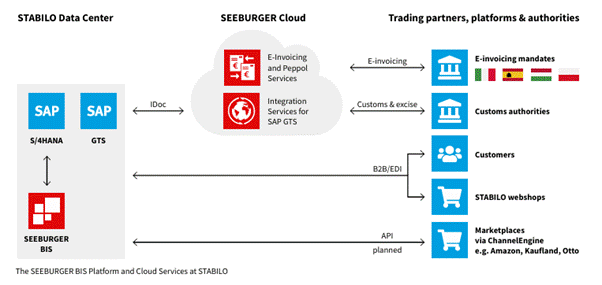
This is precisely the trade-off STABILO made: not the cheapest option per country, but the most manageable across all countries combined. The case study describes the outcome as fewer suppliers, fewer integrations, and a position ready for future obligations — including KSeF, ViDA and the French mandate.
What this tells us about provider selection
The STABILO case is not a blueprint to be followed without modification — every company’s situation differs. But the trade-offs it makes visible are recognisable for almost any organisation that invoices internationally and is facing an ERP decision or migration.
The core insight: einvoicing is not an IT project you complete. It is an ongoing compliance obligation that scales with your markets and your systems. The provider you choose must not only cover the countries of today, but also understand the architectures of tomorrow — Peppol, clearance, and the hybrid models that ViDA 2030 may further align.
More information
SEEBURGER, Partner of Peppol.now, offers international einvoicing as part of their SEEBURGER Global E-Invoicing Services. Their solution supports both Peppol models and centralised clearance systems in more than 35 countries, and integrates with SAP S/4HANA and other ERP environments.
The full STABILO case study is available as a PDF on the SEEBURGER website.
More on SEEBURGER’s einvoicing and Peppol services, SAP S/4HANA integration capabilities, and sector solutions can be found on their profile on Peppol.now.
Source: SEEBURGER AG (2024). STABILO Selects SEEBURGER To Streamline E-Invoicing Ahead Of Implementing SAP S/4HANA. Case Study. Bretten: SEEBURGER AG. Retrieved from seeburger.com.