
Peppol invoices: everything your business needs to know
Peppol invoices are becoming mandatory for businesses across Europe. Whether you operate in Belgium, the Netherlands or another EU country: the Peppol network is the standard for electronic invoice exchange. In this article you will find exactly what Peppol invoices are, how they work, what the benefits are, when they become mandatory for your organisation — and how to get started.
In this article:
- What are Peppol invoices?
- How does the Peppol network work?
- Peppol invoices vs. PDF and email
- Benefits of Peppol invoicing
- When are Peppol invoices mandatory?
- How to get started with Peppol invoices
- What does it cost?
- Frequently asked questions
What are Peppol invoices?
Peppol invoices are electronic invoices sent and received via the Peppol network. Unlike a PDF invoice sent by email, a Peppol invoice is a structured digital document processed directly by accounting packages and ERP systems — without manual data entry.
The Peppol network was established by OpenPeppol, an international non-profit organisation, and is managed in each country by a national Peppol Authority. In the Netherlands that is RVO (Netherlands Enterprise Agency); in Belgium it is Digitaal Vlaanderen/FOD BOSA.
At the core of a Peppol invoice is the UBL format (Universal Business Language): a standardised XML file that is machine-readable. Your software creates the invoice, sends it via your Peppol Service Provider into the network, and the invoice arrives automatically in your customer’s accounting system.
Definition: Peppol invoice
A Peppol invoice is a structured electronic invoice (e-invoice) in UBL format sent via the secure Peppol network from one certified participant to another. Both parties are connected via a Peppol Service Provider (which operates an Access Point, granting access to the Peppol network).
How does the Peppol network work?
Placement: After H2 ‘How does the Peppol network work?’, before first paragraph
File name: peppol-4-corner-model-diagram.jpg
Alt text: The Peppol 4-corner model: sender, Service Provider, Access Point and recipient shown schematically
Royalty-free search term: Peppol 4-corner model diagram e-invoicing (OpenPeppol.eu or Wikimedia Commons)
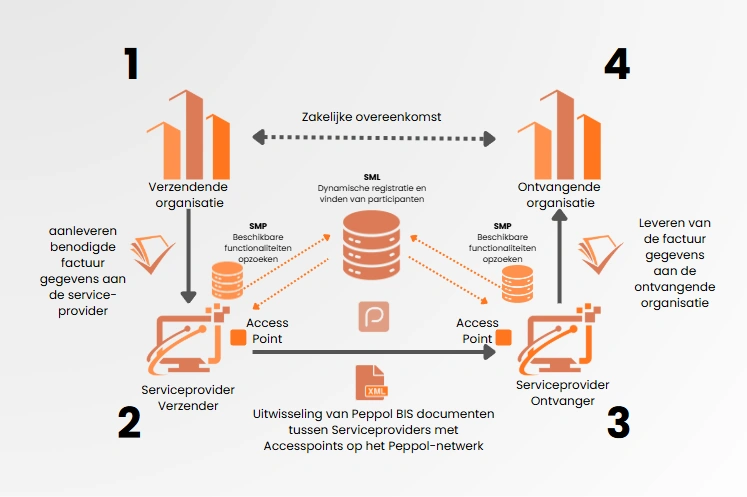
The Peppol network operates according to the 4-corner model. These are the four parties involved in every invoice exchange:
- Corner 1 – The sender: your organisation, creating the invoice in your accounting package or ERP
- Corner 2 – Your Peppol Service Provider: sends the invoice securely into the network
- Corner 3 – Your customer’s Peppol Service Provider: receives the invoice and delivers it
- Corner 4 – The recipient: your customer, where the invoice is automatically read into their system
Your Peppol ID — a unique identification number in the network — ensures invoices always reach the correct recipient. Recipients can be found via the Peppol address book, the central register of all connected participants.
If one of your customers does not yet have a Peppol Service Provider, the invoice cannot be sent via Peppol. Both parties must be connected to the network.
Peppol invoices vs. PDF and email: what is the difference?
Placement: After H2 ‘Peppol invoices vs. PDF and email’, before first paragraph
File name: pdf-vs-peppol-invoice-comparison.jpg
Alt text: Difference between a PDF invoice and a Peppol e-invoice: structured data versus unstructured document
Royalty-free search term: PDF vs structured XML invoice comparison digital (Unsplash/Pexels)
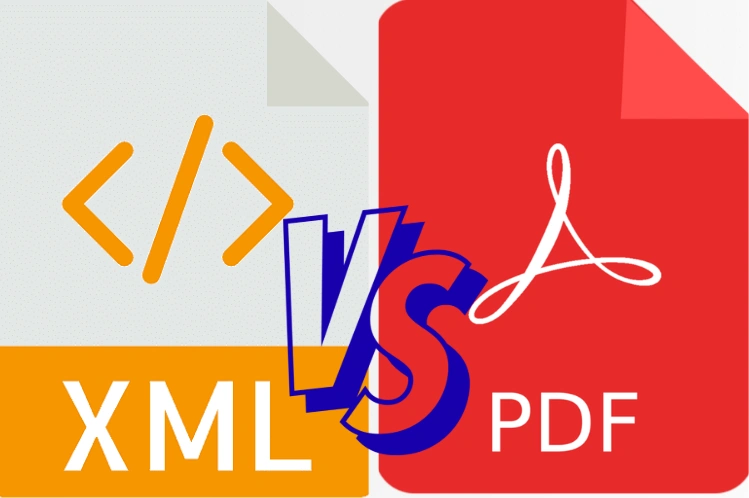
Many businesses still send invoices as PDFs by email. This appears digital, but is functionally little better than paper. The recipient must still process the invoice manually — or rely on scanning and recognition software that is prone to errors.
A Peppol invoice is fundamentally different:
- PDF: unstructured document. A person or software must ‘read’ and retype the information.
- Peppol invoice: structured XML document. Software reads the invoice directly and without errors.
- PDF: risk of typos, loss in spam or wrong inbox.
- Peppol invoice: direct, encrypted delivery via certified network.
- PDF: no standard confirmation of receipt.
- Peppol invoice: status confirmation possible via Message Level Response (MLR).
The difference is comparable to the difference between a letter in an envelope and a secure bank message: both communicate information, but one is traceable, encrypted and immediately processed.
Benefits of Peppol invoices
1. Get paid faster
Because your invoice is automatically read into your customer’s accounting system, the processing time is significantly reduced. Fewer manual steps means less delay — and therefore shorter lead times to payment.
2. Fewer errors
Manual data entry causes mistakes. With Peppol invoices, what you send is exactly what the recipient receives — including VAT amounts, reference numbers and account details. No room for interpretation, no correction requests afterwards.
3. Cost savings
Less manual processing means less staff time per invoice. Organisations that switch to Peppol invoices at scale see structural savings on accounts payable processes and accounts receivable management.
4. Automatic archiving
Peppol Service Providers generally offer automatic archiving in accordance with statutory retention periods. Your digital invoice administration is always complete and immediately retrievable.
5. Future-proof and EU-compliant
With the EU ViDA directive (VAT in the Digital Age) and growing national mandates across Europe, connecting to Peppol is an investment in long-term compliance. Countries such as Belgium, Poland, France and Croatia are already implementing mandatory e-invoicing — more will follow before 2030.
6. Cross-border invoicing
Peppol is active in more than 40 countries worldwide. With a single Peppol connection you can invoice Belgian government bodies, Dutch municipalities, French companies and Singaporean trading partners — all via the same network.
When are Peppol invoices mandatory?
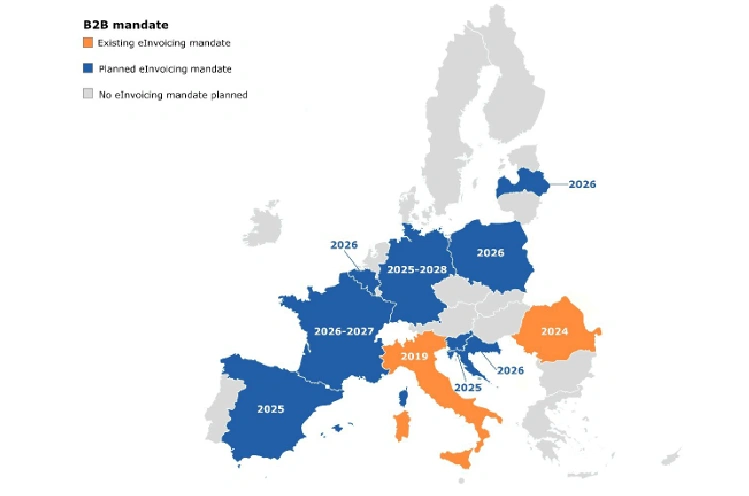
Source: How electronic invoicing helps reduce late payments in commercial transactions, 3rd Thematic Report, EU Payment Observatory, European Commission, p.12
The obligation differs per country and type of relationship (B2G or B2B):
Belgium
From 1 January 2026, all Belgian VAT-registered businesses are required to send and receive Peppol invoices for B2B transactions. For government procurement (B2G) the obligation applied earlier. A transition period until 1 July 2026 applies for the receipt obligation, but the sending obligation is already in force. Read more in our article about the Belgian e-invoicing obligation.
The Netherlands
In the Netherlands, Peppol is currently mandatory for invoices to central government and a large part of the public sector. No general obligation yet applies to B2B transactions, but the expectation is that the Netherlands will also take steps under the EU ViDA directive.
Other EU countries
Germany introduces a B2B e-invoicing receipt obligation from 2025, with a phased sending obligation through to 2028. France starts mandatory B2B e-invoicing in September 2026. Poland has made KSeF mandatory from 2026 for large enterprises. Many more countries will follow towards 2030.
Keep an eye on our Blog and News section for the current overview per country.
How to get started with Peppol invoices
Connecting to the Peppol network requires three steps:
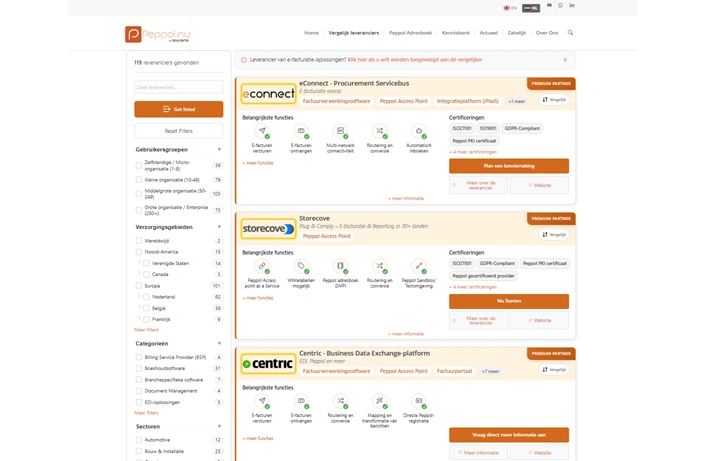
- Choose a Peppol Service Provider. This is the party that arranges your technical connection. Providers differ in price, integration options, support and additional services. Compare providers on Peppol.now
- Register your Peppol ID. Your Service Provider registers your unique Peppol ID in the network. This makes you findable to other Peppol users.
- Connect your accounting or ERP software. Most mainstream accounting packages now support direct Peppol integration. If not, Service Providers often offer a web portal as an alternative.
When choosing your Service Provider, consider: which countries are supported, which format is used (UBL, PINT, national format), and what are the total costs based on your invoice volume. Read our guide: Choosing a Peppol Service Provider: 7 steps.
What does Peppol invoicing cost?
The costs for Peppol invoices typically consist of two components:
- A monthly or annual subscription with your Peppol Service Provider
- Any transaction costs per invoice sent or received
For small businesses and sole traders with a limited invoice volume, there are providers with entry-level pricing from a few euros per month. Medium and large organisations can choose fully integrated enterprise solutions.
Important: most modern accounting packages already include Peppol functionality or offer it as an add-on. Check with your software supplier before signing a separate Service Provider contract.
Compare rates and services of certified providers via the Peppol.now comparison tool.
Frequently asked questions about Peppol invoices
What is the difference between an e-invoice and a Peppol invoice?
An e-invoice is the umbrella term for an electronic invoice. A Peppol invoice is a specific form of e-invoicing sent via the Peppol network, in a standardised UBL format, via certified Service Providers. A PDF sent by email does not qualify as a proper e-invoice in most countries.
Is Peppol free?
The Peppol network itself is an open standard and free to use. The costs lie with the Peppol Service Provider that arranges the technical connection. Those costs vary: some providers offer a free basic option, others work with subscriptions or transaction fees.
Can I send Peppol invoices as a sole trader?
Yes. There are various Peppol Service Providers that specifically cater to sole traders and small businesses. Some accounting tools — such as Moneybird, e-Boekhouden or Twinfield — already offer built-in Peppol support.
How do I send an invoice via Peppol?
You create an invoice in your accounting or invoicing software as usual. If your software supports Peppol, it automatically sends the invoice via the network to the recipient. You do not need to configure anything per individual invoice.
Is Peppol mandatory in the Netherlands?
For invoices to central government bodies, Peppol is already mandatory in the Netherlands. For B2B transactions between businesses, no general obligation yet applies, but this is expected to change in the coming years as a result of the EU ViDA directive.
What is a Peppol ID?
A Peppol ID is your unique identification in the Peppol network. It is comparable to an email address, but for invoice traffic. It typically consists of a country code plus your company registration or VAT number. Other parties can find you via the Peppol address book.
Can I transfer my Peppol ID to another Service Provider?
Yes, that is technically possible, but it requires careful coordination. There is a temporary ‘transfer window’ during which your Peppol ID may be briefly unavailable. Read more in our article: Can I take my Peppol ID to another Service Provider?.
Can I be sure my Peppol invoice has arrived?
The Peppol network is highly reliable. Your Service Provider can provide a technical dispatch confirmation. Whether your customer has actually processed the invoice depends on whether their system supports Message Level Response (MLR). Read more in: How do I know my Peppol e-invoice has arrived?
Ready to get started with Peppol invoices?
Compare certified Peppol Service Providers on our independent comparison platform and find the solution that fits your organisation — whether you are a sole trader, SME or international business.